 EN
EN


Competitive gymnastics demands equipment that meets exacting standards of stability, safety, and performance consistency. The balance beam stands as one of the most critical apparatus in artistic gymnastics, where athletes execute complex acrobatic sequences, dance elements, and precision movements at heights that leave no margin for equipment failure. Understanding what makes a balance beam stable enough for competitive athlete use requires examining the intricate engineering principles, material science, and design specifications that transform a simple elevated rail into a professional-grade training and competition apparatus capable of supporting dynamic loads, absorbing impact forces, and maintaining unwavering structural integrity throughout years of intensive use.
The stability of a balance beam for competitive use extends far beyond simple structural strength. Professional athletes generate substantial forces during tumbling passes, dismounts, and dynamic acrobatic skills that create both vertical impact loads and lateral destabilizing moments. A competition-grade balance beam must absorb these forces without wobbling, shifting, or flexing excessively, while simultaneously providing the precise surface characteristics that allow athletes to maintain balance during static poses and execute technical elements with confidence. The engineering solutions that achieve this stability involve careful consideration of base geometry, weight distribution, material selection, surface engineering, and compliance with international federation standards that govern equipment specifications for sanctioned competitive events.
Structural Engineering Principles Behind Balance Beam Stability
Base Design and Center of Gravity Management
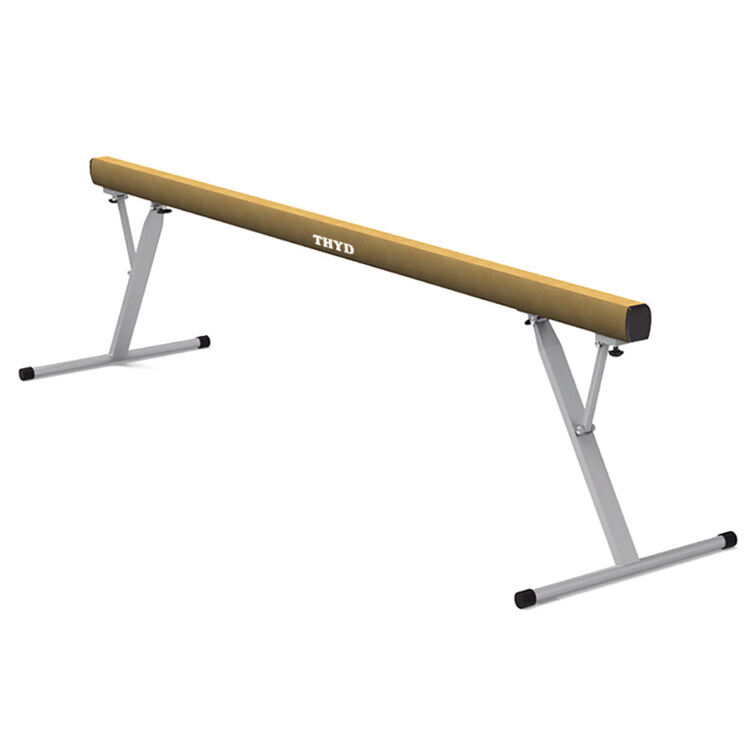
The foundation of balance beam stability begins with the base structure geometry and its relationship to the beam's center of gravity. Competition-grade balance beams employ wide, heavy bases that create a low center of gravity relative to the beam's working height. This fundamental principle of physics ensures that the tipping moment generated by lateral forces during athletic performance remains well within safe margins. Professional balance beam bases typically extend at least 1.2 to 1.5 meters in width, creating a stability footprint that resists overturning even when athletes land from height near the beam's edge. The base weight, often exceeding 150 kilograms in regulation competition models, provides additional resistance to movement through simple mass inertia.
Engineering analysis of balance beam stability involves calculating the stability ratio, which compares the restoring moment created by the equipment's weight distribution to the overturning moment generated by athlete forces. Competition balance beams maintain stability ratios well above 2.0, meaning the restoring force is at least twice the maximum expected overturning force. This safety margin accounts for the most demanding competitive skills, including high-difficulty dismounts where athletes may generate impact forces exceeding five times their body weight. The geometric relationship between base width, beam height, and mass distribution creates a stability envelope that must accommodate not just static loads but also the dynamic loading conditions characteristic of elite athletic performance.
Material Selection for Structural Integrity
The materials comprising a competition balance beam directly influence its stability characteristics through their mechanical properties, weight, and structural performance under load. High-grade balance beams utilize laminated wood cores, typically constructed from select hardwoods such as maple or beech, which provide excellent strength-to-weight ratios and consistent mechanical properties. These hardwood cores resist deflection under load while maintaining sufficient rigidity to prevent excessive flexing that would compromise athlete balance. The lamination process itself enhances structural stability by orienting wood grain in alternating directions, creating a composite structure that minimizes warping, twisting, and dimensional changes in response to environmental conditions.
Steel reinforcement elements within the balance beam structure provide additional rigidity and distribute loads across the beam's length. Internal steel rods or plates, strategically positioned within the beam profile, increase the moment of inertia of the cross-section, which directly correlates to bending resistance. This hybrid construction approach combines the natural resilience and surface characteristics of wood with the structural strength and stability of steel reinforcement. The base framework typically employs heavy-gauge steel tubing or channel sections welded into rigid geometric configurations that maintain dimensional accuracy under repeated loading cycles. Premium competition balance beams may incorporate up to 80 kilograms of steel reinforcement in the base structure alone, contributing significantly to overall stability through both added mass and structural stiffness.
Connection Systems and Joint Integrity
The stability of a balance beam depends critically on the integrity of connections between the elevated working surface and the supporting base structure. Competition-grade equipment employs engineered connection systems that eliminate play, prevent loosening under vibration, and maintain precise alignment throughout the equipment's service life. Bolt patterns in professional balance beams typically utilize large-diameter fasteners, often M12 or larger, with thread-locking mechanisms that prevent gradual loosening from repetitive impact loads. Connection points distribute forces across multiple fasteners and incorporate load-spreading plates or reinforcement brackets that prevent stress concentration in the beam structure.
Height adjustment mechanisms in regulation balance beams must maintain stability across the entire adjustment range, from floor-level training height to the regulation competition height of 125 centimeters. Telescoping support columns or multi-position locking systems achieve this adjustability while preserving structural rigidity. High-quality adjustment mechanisms employ positive locking designs with multiple engagement points that create rigid connections equivalent to fixed-height construction. The engineering challenge involves creating adjustment capability without introducing mechanical play or reducing torsional rigidity. Premium balance beam designs address this through precision-machined components with tight tolerances and robust locking mechanisms that clamp adjustment elements with sufficient force to prevent any movement during use.
Dynamic Load Management and Impact Absorption
Understanding Forces Generated During Competitive Skills
Competitive gymnasts generate substantial forces during balance beam routines that equipment must absorb while maintaining stability. Biomechanical studies of elite gymnastics skills reveal that landing forces from acrobatic elements can reach peak magnitudes of 8 to 12 times the athlete's body weight, delivered in impact durations as brief as 50 to 100 milliseconds. These dynamic loads create both vertical compression forces and horizontal shear forces that challenge balance beam stability. A layout dismount from a 60-kilogram athlete, for example, may generate instantaneous vertical forces approaching 700 newtons, combined with lateral forces exceeding 200 newtons if the landing occurs off-center.
The stability requirements for balance beams extend beyond simply resisting these peak forces. The equipment must also manage the vibration and oscillation that follow impact events. Insufficient damping in the balance beam structure allows prolonged vibration that interferes with athlete performance and creates perceived instability even when the equipment remains physically secure. Competition balance beams incorporate damping mechanisms, including elastomeric pads between structural components and energy-dissipating materials in the base construction, that attenuate vibration within 0.5 to 1.0 seconds following impact. This rapid vibration decay allows athletes to immediately transition to subsequent skills without waiting for equipment oscillation to subside.
Surface Compliance and Its Effect on Stability
The working surface of a competition balance beam incorporates carefully engineered compliance characteristics that affect both athlete performance and overall equipment stability. Regulation balance beams feature a 10-centimeter wide working surface covered with specialized materials that provide controlled deformation under load. This surface compliance serves multiple functions: it reduces peak impact forces through energy absorption, provides tactile feedback for athlete balance control, and distributes point loads across the beam structure. The suede or synthetic leather covering, combined with underlying foam padding typically 3 to 6 millimeters thick, creates a surface that compresses slightly under foot pressure while maintaining sufficient firmness for push-off during dynamic skills.
The relationship between surface compliance and balance beam stability involves balancing competing requirements. Excessive surface softness improves impact absorption but may create a sensation of instability as the surface deforms unevenly under athlete movements. Insufficient compliance increases impact forces and provides harsh tactile feedback that makes balance control more difficult. Competition balance beams optimize this balance through multi-layer surface construction with carefully specified material properties. The surface system typically includes a firm support layer that maintains consistent geometry, an intermediate foam layer providing controlled compliance, and an outer covering offering appropriate friction characteristics. This engineered surface system maintains consistent performance across the beam's length and preserves its mechanical properties through thousands of training contacts.
Vibration Control Technologies
Advanced competition balance beams incorporate specific technologies to control vibration and enhance stability perception. Tuned mass dampers, though more commonly associated with building engineering, find application in premium balance beam designs where small weights are strategically positioned within the beam structure to counteract natural vibration frequencies. These passive damping systems absorb vibrational energy and reduce the amplitude of oscillations following impact events. The engineering principle involves matching the damper's natural frequency to the beam's fundamental vibration mode, creating destructive interference that rapidly dissipates vibrational energy.
Alternative vibration control approaches include constrained layer damping, where viscoelastic materials are sandwiched between structural layers within the balance beam construction. As the structure flexes during use, these intermediate layers undergo shear deformation that converts mechanical energy into heat, effectively removing energy from the vibrating system. Competition balance beams may also employ elastomeric isolation pads between the beam structure and base, creating a mechanical filter that prevents vibration transmission while maintaining overall structural stability. These isolation elements must be carefully calibrated to prevent excessive movement while providing effective vibration attenuation. The result is balance beam equipment that feels solid and stable to athletes while actually incorporating sophisticated mechanical systems that manage dynamic forces and control unwanted motion.
Dimensional Specifications and Geometric Stability Factors
Regulation Dimensions and Their Stability Implications
International gymnastics federations establish precise dimensional requirements for competition balance beams that directly influence stability characteristics. The regulation beam length of 5 meters creates specific structural engineering challenges, as this span must resist deflection under center loading while maintaining uniform stiffness across its entire length. The prescribed height of 125 centimeters above the competition floor places the working surface at an elevation that increases the potential energy of falling athletes and elevates the center of gravity of the entire equipment assembly. These dimensional constraints require careful engineering to maintain adequate stability margins.
The 10-centimeter working width, while appearing modest, actually represents an optimized dimension that balances athlete skill demonstration requirements with safety considerations. From a stability perspective, this narrow width concentrates athlete loads along the beam's longitudinal centerline, maximizing the effectiveness of structural reinforcement positioned along this axis. The beam profile typically measures 13 to 16 centimeters in total depth including surface padding, providing sufficient structural depth for effective bending resistance. The aspect ratio between beam depth and span length, approximately 1:30 to 1:40, falls within ranges that permit adequate stiffness without requiring excessive structural mass that would compromise portability and adjustability.
Base Footprint and Floor Contact Characteristics
The contact interface between a balance beam base and the floor surface plays a crucial role in overall stability. Competition balance beams typically incorporate adjustable leveling feet with large contact areas that distribute equipment weight across the floor surface and prevent localized pressure that could cause settling or movement. These feet often feature non-slip elastomeric pads or textured surfaces that increase friction coefficients with typical gymnasium flooring materials. The coefficient of static friction between base feet and floor should exceed 0.6 to prevent horizontal sliding under the lateral forces generated during athletic performance.
Professional balance beam installations may include floor anchoring provisions for permanent or semi-permanent setups in dedicated training facilities. Anchor points allow mechanical connection to floor structures, providing absolute stability that eliminates any possibility of equipment movement. However, most competition balance beams must function as free-standing equipment that can be positioned and repositioned as needed. The base geometry creates a stability polygon defined by the outer perimeter of floor contact points. For optimal stability, this polygon should encompass the vertical projection of the beam's center of gravity with substantial margin. Competition balance beam bases typically create stability polygons with safety factors of 1.5 to 2.0, meaning the center of gravity would need to shift 50 to 100 percent beyond its normal position to approach tipping conditions.
Height Adjustability Without Compromising Stability
The requirement for height adjustability in training balance beams introduces engineering challenges for maintaining stability across the adjustment range. As beam height increases, the lever arm for lateral forces grows proportionally, increasing the overturning moment generated by off-center landings. Effective balance beam designs compensate for this through base width that scales appropriately with maximum height, ensuring adequate stability margins at all adjustment positions. Adjustment mechanisms must lock positively without introducing mechanical play that would allow beam movement within the connection system.
Premium adjustable balance beams employ telescoping columns with multiple locking positions, each providing equivalent structural rigidity. The locking mechanisms often utilize spring-loaded pins engaging precision-drilled holes, creating positive connections that maintain alignment and prevent rotation. Some designs incorporate continuous adjustment systems using threaded columns with large-diameter locking collars, providing infinite height adjustment within the specified range. Regardless of mechanism type, the engineering requirement remains constant: the adjustment system must maintain the same structural integrity and stability as fixed-height construction. Testing protocols for competition balance beams verify stability at maximum height under prescribed loading conditions, ensuring equipment safety across the full range of operating configurations.
Safety Standards and Stability Testing Protocols
International Gymnastics Federation Requirements
The International Gymnastics Federation establishes comprehensive standards for competition balance beams that include specific stability requirements. These standards define minimum base dimensions, maximum allowable deflection under specified loads, and testing protocols that verify equipment performance. Competition balance beams must demonstrate deflection not exceeding 20 millimeters at beam center under a 100-kilogram static load, ensuring sufficient structural stiffness for athletic use. Dynamic stability tests apply rapid loading cycles simulating landing impacts, verifying that equipment maintains position without shifting or tipping.
Certification testing for balance beams includes stability verification under eccentric loading conditions, where forces are applied at the extreme edges of the working surface to simulate worst-case athlete landing positions. Equipment must remain stable without tipping or sliding when subjected to lateral forces equivalent to 30 percent of the vertical load capacity applied at maximum height. These rigorous testing standards ensure that certified competition balance beams provide consistent stability characteristics regardless of manufacturer or specific design approach. Facilities hosting sanctioned gymnastics competitions must verify that equipment meets current federation standards, with documentation and periodic re-certification confirming ongoing compliance.
Load Testing and Structural Verification
Professional balance beam manufacturers conduct extensive load testing during product development to verify structural integrity and stability performance. Static load tests apply forces well beyond expected service loads, typically 1.5 to 2.0 times the maximum anticipated athlete weight, to verify adequate safety factors in structural design. These tests measure deflection characteristics, verify connection integrity, and ensure that no permanent deformation occurs under maximum rated loads. Dynamic load testing simulates repetitive impact loading through thousands of loading cycles, replicating years of athletic use in accelerated testing protocols.
Stability testing protocols subject balance beams to lateral forces, torsional moments, and combined loading conditions that replicate the complex force environments generated during competitive gymnastics. Test equipment applies calibrated forces at specific locations while monitoring equipment displacement and base lifting. Acceptable performance requires that the balance beam maintains position with base feet remaining in floor contact under all specified loading conditions. Advanced testing may include vibration analysis using accelerometers to measure equipment response characteristics and verify effective damping. These comprehensive testing protocols ensure that balance beams entering competitive use provide reliable stability under the demanding conditions of elite athletic performance.
Maintenance Requirements for Sustained Stability
Maintaining balance beam stability throughout its service life requires systematic inspection and maintenance procedures. Connection hardware, particularly adjustment mechanism fasteners and beam-to-base mounting bolts, requires periodic inspection and re-torquing to ensure continued tightness. Facilities should implement quarterly inspection schedules that verify fastener tightness, check for structural damage or deformation, and assess the condition of wear components such as leveling feet and surface padding. Any looseness in adjustment mechanisms or play in structural connections compromises stability and requires immediate attention.
Surface condition monitoring ensures that padding compression and covering wear do not affect balance beam performance characteristics. The working surface should maintain uniform compliance across its length, with padding thickness remaining within specified tolerances. Uneven padding compression creates inconsistent surface characteristics that may affect athlete balance control. The beam structure itself should be inspected for signs of deformation, checking that the working surface remains level and straight across its length. Properly maintained competition balance beams retain their stability characteristics for decades of service, while neglected equipment may develop stability issues that compromise safety and performance. Documentation of maintenance activities and inspection findings creates accountability and ensures that equipment condition receives appropriate attention in demanding training environments.
Advanced Stability Features in Modern Competition Equipment
Modular Design Systems
Contemporary competition balance beams increasingly employ modular design approaches that facilitate transportation while maintaining structural integrity and stability in assembled configuration. These systems separate the beam into manageable sections that connect through precision-engineered joints, creating assembled structures with performance equivalent to one-piece construction. Connection systems in modular balance beams utilize large-diameter alignment pins combined with through-bolts that clamp sections together with substantial force. The engineering challenge involves creating joints that maintain rigidity equivalent to continuous structure while permitting repeated assembly and disassembly cycles.
Modular base designs separate the supporting structure into components that nest for storage and transport, then expand into full-width configurations for use. Locking mechanisms secure base extensions in deployed positions, creating rigid structures that maintain full stability despite sectional construction. High-quality modular systems incorporate precision manufacturing with tight tolerances that ensure consistent alignment and eliminate accumulated play across multiple connection points. When properly engineered and assembled, modular balance beams provide stability performance indistinguishable from fixed construction while offering practical advantages for facilities requiring equipment mobility or storage efficiency.
Smart Monitoring Technologies
Emerging technologies integrate sensors and monitoring systems into competition balance beams that provide real-time feedback on equipment condition and performance. Strain gauges embedded within beam structures measure deflection during use, providing data on loading patterns and structural response. Accelerometers monitor vibration characteristics, detecting changes that might indicate developing structural issues or connection loosening. These monitoring systems can alert facility managers to maintenance needs before stability degradation becomes apparent to athletes or coaches.
Advanced sensor integration enables performance analysis applications where force data from balance beam impacts contributes to athlete training and skill development. Load cells in base structures measure impact magnitudes, providing objective data on landing forces and technique efficiency. While these technologies serve primarily analytical purposes, they also contribute to safety by verifying that equipment performs within designed parameters and alerting users to abnormal conditions. The implementation of smart monitoring represents an evolution in balance beam engineering, where equipment transitions from passive structural systems to active monitoring platforms that support both athletic performance and facility management requirements.
Environmental Adaptation Features
Professional balance beams incorporate design features that maintain stability across varying environmental conditions. Temperature fluctuations affect material dimensions and mechanical properties, potentially compromising structural integrity and connection tightness. Competition balance beams utilize materials and construction methods that minimize temperature sensitivity, including dimensionally stable wood species, thermal expansion-compensating connection systems, and materials with matched thermal expansion coefficients. Climate control in training facilities helps maintain consistent equipment performance, but quality balance beams must tolerate reasonable environmental variations without stability degradation.
Humidity control presents particular challenges for balance beam equipment due to the hygroscopic nature of wood structural components. Moisture absorption causes dimensional changes that may affect surface geometry and connection tightness. Premium balance beams employ moisture-resistant finishes and sealers that stabilize wood components against humidity fluctuations. Some designs incorporate synthetic structural materials that eliminate moisture sensitivity entirely, though these alternatives must replicate the performance characteristics that make wood components effective for balance beam construction. The engineering objective involves creating equipment that maintains consistent stability and performance characteristics across the range of environmental conditions encountered in gymnastics facilities worldwide, ensuring reliable performance regardless of climate or seasonal variation.
FAQ
What is the minimum base width required for a competition balance beam to remain stable?
Competition-grade balance beams typically require base widths of at least 1.2 to 1.5 meters to provide adequate stability for elite athletic use. This dimension creates a stability footprint that resists tipping under the lateral forces generated during high-difficulty skills and landings. The specific base width requirement depends on beam height, total equipment weight, and the center of gravity location within the assembled structure. Regulation competition equipment at 125 centimeters height should feature base widths approaching or exceeding 1.5 meters to maintain appropriate safety factors. Facilities can verify adequate base width by ensuring the stability polygon created by floor contact points encompasses the beam's center of gravity with substantial margin, typically maintaining safety factors of 1.5 or greater against tipping under maximum rated lateral loads.
How do height adjustments affect balance beam stability?
Height adjustments directly impact balance beam stability by altering the lever arm for lateral forces and raising the equipment's center of gravity. As beam height increases, the overturning moment generated by off-center landings grows proportionally, requiring wider bases or heavier construction to maintain equivalent stability margins. Quality adjustable balance beams compensate through base designs that provide adequate stability at maximum height, ensuring safe operation across the full adjustment range. Adjustment mechanisms must lock positively without introducing mechanical play that allows beam movement. Users should verify that locking mechanisms engage fully at each height setting and that no wobbling or shifting occurs during use. Facilities should follow manufacturer specifications for maximum operating height and avoid extending equipment beyond rated limits, as stability margins decrease with increased height and may become inadequate if equipment is used outside designed parameters.
Can older balance beams be upgraded to meet current stability standards?
Upgrading older balance beam equipment to meet current stability standards depends on the specific deficiencies and the equipment's fundamental design. Simple improvements such as replacing worn leveling feet, re-torquing connection hardware, and adding elastomeric damping pads can enhance stability in equipment with sound structural design. However, fundamental design limitations such as insufficient base width, inadequate structural reinforcement, or worn connection mechanisms may not be economically correctable. Facilities considering upgrades should engage qualified equipment inspectors or structural engineers to assess whether modification can achieve required stability levels or whether replacement represents the more appropriate solution. In many cases, the cost and complexity of substantial modifications approach or exceed the investment required for new equipment that incorporates current engineering standards and safety features. Facilities using older equipment should at minimum conduct thorough stability testing and implement appropriate use restrictions if equipment no longer meets standards for high-level competitive training.
What role does floor surface quality play in balance beam stability?
Floor surface characteristics significantly influence balance beam stability through their effect on friction and load distribution at base contact points. Smooth or polished floor surfaces reduce friction coefficients, increasing the potential for horizontal sliding under lateral forces. Uneven floors create rocking conditions where equipment may shift as loading transfers between base feet at different elevations. Optimal balance beam stability requires level floors with sufficient texture or resilience to maintain high friction with equipment feet. Competition gymnastics facilities typically feature sprung floor systems or foam-backed carpet surfaces that provide excellent friction characteristics while offering some compliance that helps distribute contact loads. Facilities with slick surfaces can improve stability through floor treatments that increase friction or by using balance beam models with aggressive tread patterns on leveling feet. Equipment placement should avoid floor transitions, seams, or damaged areas that create uneven support conditions. Regular floor inspection and maintenance ensure consistent surface properties that support reliable equipment stability throughout training and competition activities.